|


BELGIAN HORSES
The Belgian, as the name implies, is
native to the country of Belgium and is one of the largest, heaviest
and strongest breeds of horses. This little country is blessed
with fertile soil and abundant rainfall providing the thrifty
farmers of Belgium with the excellent pastures and the hay and grain
necessary to develop a heavy, powerful breed of
horses.Belgium lies in the very center of that area of
Western Europe which gave rise to great black horses known as
Flemish horses and were referred to as the "great horses" by
medieval writers. They are the horses that carried armored knights
into battle. Such horses were known to exist in that part of Europe
in the time of Caesar. They provided the genetic material from which
nearly all the modern draft breeds were fashioned. Draft horses are
large, heavy, powerful animals.
THE SHIRE
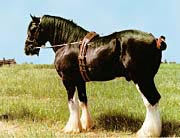 The Shire horse, developed in England, is the largest of all horses. A shire can
weigh over 2200 pounds. This breed traces it's
history to the days of the Roman Conquest and is one of the oldest
of the well-defined draft breeds. The name "Shire" also comes from
England, and derives its name from the Saxon word "schyran," which
means to shear or divide, hence the name "Shire," that is synonymous
with county. King Henry VIII first applied the name "Shire" to the
horse early in the 16th century.The Shire was found and developed in all parts of England, but the
counties of Lincoln, Derby, Cambridge, Norfolk, Nottingham,
Leicester and Huntington, were the special homes. These are
presently termed as the Midlands. History mentions the horse by
different names notably, the Great Horse, the War-Horse, the Cart
Horse, the Old England Black Horse, the Lincolnshire Giant and the Shire.
The Shire horse, developed in England, is the largest of all horses. A shire can
weigh over 2200 pounds. This breed traces it's
history to the days of the Roman Conquest and is one of the oldest
of the well-defined draft breeds. The name "Shire" also comes from
England, and derives its name from the Saxon word "schyran," which
means to shear or divide, hence the name "Shire," that is synonymous
with county. King Henry VIII first applied the name "Shire" to the
horse early in the 16th century.The Shire was found and developed in all parts of England, but the
counties of Lincoln, Derby, Cambridge, Norfolk, Nottingham,
Leicester and Huntington, were the special homes. These are
presently termed as the Midlands. History mentions the horse by
different names notably, the Great Horse, the War-Horse, the Cart
Horse, the Old England Black Horse, the Lincolnshire Giant and the Shire.
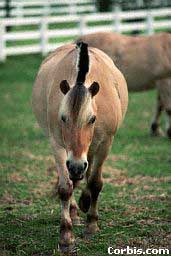
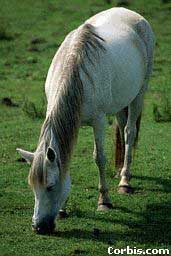
Buckskin and Wild Baker Pony.
THE CLYDESDALE
The Clydesdale Horse, so
utterly synonymous with the phrase 'Horse Power' began to develop as
a breed in the early part of the 1700's. This breed is also one of
the largest, heaviest and strongest breeds of horses. As the name implies, they originated from the valley of the River Clyde (world famous for the
shipbuilding activities in its lower reaches within the City of
Glasgow) in the area comprising the upper wards of the County of
Lanarkshire.
Informed legend has it that one of the Dukes of
Hamilton wanted to cut a dash with some splendid coaching stallions
and so he imported big black Flemish Stallions from the low
countries of Europe. He generously allowed his tenant farmers to
mate their 'scotch' mares with his imported blood and the resultant
offspring were considered superior to both their sires and dams.
These farmers, realizing that they had something rather special in
the way of horse flesh, carefully developed the breed amongst
themselves and before long they had an animal that was widely sought
after.
The Clydesdale spread rapidly from Southern Central Scotland to Northern England, Ireland and
northwards through Scotland itself. The sales at the market town of
Lanark became renowned and in the heyday of the breed, hundreds if
not thousands were sold in a matter of days. Now in present time,
this large, impressive sized horse draws hundreds, if not thousands of people to
a single exhibitions throughout the world. Clydesdale horses are usually one of
the highlights of a parade, as they work in teams, pulling massive wagons.
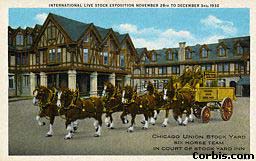
Clydesdale Horses

Cowboys
Place
The Stable
Doors
Tricia's
Little Bit of Trouble
Denise's
Horse
Silversha's
Horse Graphics
Casey's
Horses
Horse
Haven
Graphic by
Lalla's Countryside
Lisa's Country Clip Art
Made from the Heart
Country Patch Collectables
Page Design and Content Copyright Cockatiel Cottage.
Copyright Graphics are NOT Public Domain.
|
|